
Table of Contents
This Week
We’ll get round to the Leveson Inquiry in a minute; we don’t want to appear preoccupied with the thing.
The important news is that Tabloid, the movie based on (but not giving credit to) Tony Delano’s brilliant book, Joyce McKinney and the Case of the Manacled Mormon goes on general release next week. Apparently, the BBC plans to screen it next year, after everybody who wants to, will have seen it.
Our advice is that if you want to see examples of Fleet Street’s finest at work – including a photographer (Kent Gavin, of course) becoming Reporter of the Year – you should buy the book. Better value, better fun, better story, better told.
Joyce herself, poor old tart, still doesn’t seem sure whether it’s good for her image or not (it’s not), so she’s employed Shyster, Shyster, and Shyster to look after her interests. Still, the news of the film’s release brought back memories for Tim Minogue – about the first scoop on the story and a photographer who didn’t win any awards at all.
Roland Gribben forgot to send a birthday card to his old chief reporter Guy Rais, so he’s written a piece about him, instead.
John Shone writes about how Fleet Street tumbled to the cost of living. What’s that got to do with the price of fish? That’s where it started.
New reader Phil Johnson remembers great days in Ancoats Street.
And so we come to the Leveson Inquiry.
The jury may still be out on whether journalists nicked pictures in the old days (but there is no evidence yet to suggest that we did). Peter Smith says that he didn’t, but he remembers being asked to return one that he’d borrowed. And Paul Fievez compares the differences between then and now (apparently stealing, or using photos without permission, is common practice these days).
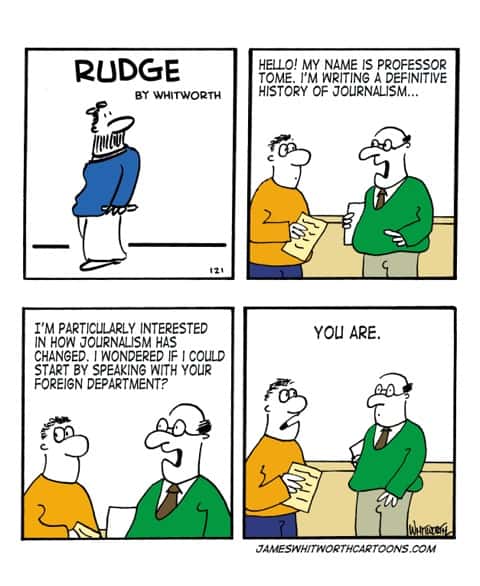
And as usual, Rudge props the whole thing up.
#
Monkey business
By Tim Minogue
Ranters readers will remember how, in autumn 1977 and spring 1978, the nation was gripped by the Case of the Manacled Mormon. A former Miss Wyoming, Joyce McKinney, had for three days, with the aid of a male accomplice, Keith May, held prisoner a young missionary, Kirk Anderson, with whom she was sexually obsessed.
At a subsequent court hearing it was revealed that, after kidnapping Anderson, the former beauty queen had kept him manacled to a bed and had forced him to have quite a lot of sex, supposedly against his will.
McKinney famously told the court: ‘I loved Kirk so much that I would have skied down Mount Everest in the nude with a carnation up my nose.’
This is now the subject of a documentary film, Tabloid, by Errol Morris, which tells the story of the media frenzy surrounding the case, in particular how the Molloy Mirror scooped the Jameson Express, which bought up Joyce’s super-sanitized story, with revelations of her escort girl past, nude photos and all.
As ajunior reporter on the Mirror Group’s Plymouth training scheme, I played a very small and inglorious part near the beginning of the saga.
I was on the Tavistock Times and had been seconded to its sister paper, the Okehampton Times, for the week. My senior colleague, David France, had a tip from a police contact that we should head up on to Dartmoor, where we’d find ‘something very interesting’.
As tips go, it was one of the vaguest – Dartmoor being a rather large area – but we had a bit of luck. Driving rather aimlessly about we spotted an unmarked Ford Escort ahead of us. It was pale blue and had an unusually large aerial. That and the fact that two large coppers were in it gave it away as a police vehicle.
We followed it to a remote farmhouse, which, it turned out, was where McKinney had had her way with young Kirk — and the Okehampton Times had beaten the world’s press to it.
We arrived shortly after McKinney and the exhausted Mormon had been taken away, but police had not had time to seal off the site properly. The breakfast things were still on the kitchen table, although sadly no manacles were in evidence.
‘Quick! Get some pictures before we get kicked out of here,’ we told the local wedding photographer – whose name I forget – who worked part-time for the paper. Pause. ‘Come on…’ Silence. ‘What’s up?’
‘Er, there doesn’t seem to be any film in the camera.’
By the time David and the shame-faced snapper had returned from the 15-mile round trip to Okehampton, I’d been booted off the farm and the police had set up a cordon about half a mile away, so the only picture anyone could get of the place was a distant one of the roof.
And by then, of course, various hacks from the nationals had turned up, including Geoffrey Lakeman (then in his final weeks at the Telegraph, before moving the Mirror) and the Mirror’s Syd Young. So I made a few quid out of them. But there was to be no Inside-Sex-in-Chains-Love-Nest photo scoop.
These days the photographer would have avoided the no-film situation, by having a digital camera. But would, no doubt, have neglected to charge the battery.
#
Editor’s note
A Mr. Shyster writes:
Joyce McKinney, subject of Errol Morris’ documentary Tabloid, has filed suit in Los Angeles Superior Court against the filmmaker and other individuals and associated companies such as Moxie Films, Sundance Select, and IFC Films. McKinney alleges among other things misappropriation of likeness, defamation, misrepresentation, fraud, intentional infliction of emotional distress, and breach of contract. McKinney asserts in the suit that she was approached in 2009 and led to believe that her cooperation in a project for a Showtime series would help clear her name in connection with a long-ago scandal. Instead, she claims, the resulting movie held her up to public ridicule and reinforced a false image of her as having kidnapped a Mormon missionary in England in 1977 and holding him against his will and repeatedly raping him. She was arrested and British tabloids and TV had a field day with what became known as the ‘Manacled Mormon’ story. McKinney maintains that she was rescuing her fiancé from a cult.
In an effort to gain access to photographs, home movies, and other memorabilia, the suit claims, representatives of Morris including a person identified as Ajae Clearway and Mark Lipson repeatedly badgered her and tricked her into letting them carry away plastic bins full of newspaper clippings and other material that Morris was allegedly going to peruse for images he could use in the documentary — which plaintiff maintains she had been falsely led to believe would be part of a Showtime series. Additionally, McKinney alleges that during the course of her interactions with people associated with making the movie, Lipson agreed to help save the service dog that was scheduled to be put to death at a pound but instead allowed it to happen then taunted her about it.
In November 2010 McKinney says in the suit she traveled to New York City to the Doc NYC festival to see the film that Morris had made. Afterward, she became distressed at ‘having been deceived’ about how she would be depicted, the movie’s revival of the ‘Manacled Mormon’ story and the use of personal memorabilia she claims was stolen as well as many purportedly false and negative statements and portrayals in Tabloid. McKinney is seeking unspecified compensatory, punitive, and other damages as well as civil penalties, attorneys’ fees, and court costs.
#
Gentleman of the press
By Roland Gribben
Private Eye dubbed him ‘Gentleman Guy Rais’ when he ticked off fellow reporters because he felt they had been discourteous to then Labour Prime Minister James Callaghan.
Guy attracted many other sobriquets during a Fleet Street career stretching over 35 years with the Daily Telegraph and embracing everything from cod wars to a pub crawl with the Duchess of Argyll.
He buzzed like a bee, dressed in Telegraph grey and his trademark slimline moustache gave him an understated air of authority. He could be mildly explosive, appropriate of course for a man born on November 5, 1919, and named Guy. ‘Silly old fool,’ was a frequent signing off the sound after unproductive phone calls.
He’s just celebrated his 92nd birthday, cementing his position as the Telegraph’s oldest surviving newsroom based reporter. (Clare Hollingworth, former defense corr, at 100 has the edge in terms of years but not unbroken service). He was the consummate professional capable of infiltrating a restricted Vatican conference with the aid of a London Underground pass and .displayed diplomatic talents in exclusively obtaining the photo-finish picture of a Goodwood race where blinkered stewards had named the wrong horse as a winner and rushing it to Fleet Street.
He went home with 10 bob – the equivalent of 50p – for his first week’s effort as a very junior reporter on the Evening Argus in Hastings in 1936. Wartime service found him in the Middle East, producing a news sheet based on BBC bulletins after a hazardous episode at St Nazaire and post-war a spell on the Eastbourne Chronicle was followed by the move to the Telegraph as South Coast correspondent.
He arrived in Fleet St in grand style with the news editor of the day waiting outside 135 to send him on his first assignment – a murder case – in a chauffeur-driven Daimler.
Guy’s acquaintance with prime ministers did not start and end with Callaghan. He had an intriguing encounter with Winston Churchill after being sent down to Chartwell for a health check story. A grumpy Churchill was alarmed at being found by Guy outside walking and gave the startled reporter a piece of his mind. Churchill twice phoned Viscount Camrose, the Telegraph proprietor at the time, eventually explaining that he didn’t want anything reported about being seen outside his home because he had called off a weekend with the Queen on the grounds that he wasn’t well.
Churchill’s comment that Guy had been courteous and restrained provided lift-off for the Rais career. He was effectively chief reporter in the days before the title had been discovered. Major court cases became his specialty. They included the murder trial of Dr. Bodkin Adams, the Eastbourne physician who had been GP to Guy’s mother and Margaret, Duchess of Argyll, who gave birth to the Telegraph’s famous or infamous Page 3.
His foreign correspondent’s career blossomed with the US troop landings in Beirut, the Nyasaland riots, and the Algerian civil war among a long list of credits. He scooped the world with a powerful interview with General Jacques Massu, de Gaulle’s ally, during the Algerian conflict and was rewarded by having it on the front page of Le Monde. Furious French reporters took their revenge when they used Guy’s bowler – the identification for a neutral – as a pissoir.
Belated happy birthday, Guy
#
Fishy business
By John Shone
Reading Ian Kerr’s tribute to Clive Crickmer and his account of the tedious jobs given to juniors on the Evening Chon at Newcastle (Ranters Oct 21) reminded me of the mind-bogglingly boring tasks that I had to undertake in the early days of my career.
After a stint as a copy boy in the newsroom of The Sporting Life, I pestered my way to the top floor of 107-109 Fleet St and the offices of Fishing News, the weekly trade paper for those brave souls who plied their trade in the coastal waters of the British Isles and the cruel seas off Iceland in trawlers, herring drifters and similar craft
‘I’m afraid the job’s gone,’ said editor Lloyd Butcher, when I phoned to enquire about a vacancy for an editorial assistant that I’d seen in World’s Press News. But encouragingly, he added: ‘We might have something else coming up in a few weeks.’
I rang him virtually twice a week for the next month… until the kindly Scot finally relented and called me in for an interview.
A week later, I was boarding a No 4A bus from Islington to Ludgate Circus to take my place as a proud protégé of the news editor, Mr. Thomas H Bailey.
In between making copious amounts of tea and running errands to Jolly’s sandwich shop on Ludgate Circus, I found myself churning out fishy stories from places as far afield as Mallaig and Mevagissey, Lerwick and Lowestoft, Peterhead and Port Isaac.
I never got to visit them. It was all done on the phone, or by processing the lineage copy that came in from our stringers on the Aberdeen Press and Journal, the Hull Daily Mail, the Grimsby Evening Telegraph, the Fleetwood Gazette…
But I did make it to… Billingsgate, where, thanks to the cheery market porters, I quickly expanded my vocabulary. Every Tuesday I took the bus from outside the Daily Telegraph offices to wend my way around the fish wholesalers to pick up the latest market trends in cod, halibut, lobsters, whelks, and prawns.
To these, I added statistics on catches from ports around the country to produce a whole page of fish prices that were analysed avidly by those in the know, in the same way, that the gambling fraternity studies horse-racing form. There was no room for error, I was told sternly. Livelihoods depended on it.
To me, as a 17-year-old, it was a bit of a bore, but I just had to get on with it, along with filing countless photographs of fishing boats, counting the lineage so that contributors could be paid, and ending my day with a trip to the parcels office at Waterloo station to put the day’s output of the editorial team on the train to our printers in Poole.
Every Friday, when the results of the printers’ labours arrived in Fleet St, there was another important, but menial, the task to perform: The Retrospect. It involved going through the paper and summarising the main stories of the week. This was Mr. Bailey’s idea …to make sure that there was no shortage of copy when Christmas came around and the usual flow of material from our stringers dried up.
For the Yuletide edition, two or even three pages were given over to The Year In Retrospect. It worked well… until the lad who took over from me when I was given extra subbing responsibilities became rather lax and decided that he couldn’t be bothered with the weekly chore.
Now, being a part-time chorister at St Paul’s Cathedral, Mr. Bailey never swore, but you could hardly measure the height of his dudgeon when he asked for the Retrospect copy a week or so before Christmas and found that The Year comprised just eight lines. My lazy colleague spent several long nights delving back through the files… and a week or two later he was delving into the job vacancies for a new position.
After three years of Mr. B’s tutelage, it was time to move on, and attending a food trade conference with other trade press journalists I was fortunate to meet T E Clark, editor of the Grocers’ Gazette, who examined my shorthand as I sat next to him and promptly offered me a job at £500 a year more than I was getting at Arthur J Heighway Publications.
There was just one snag: because of my experience with the fish markets, I was to take responsibility for updating the Price Guide, the Gazette’s monthly supplement which listed the price of everything from Kellogg’s Cornflakes to Oxo cubes so that grocers across the land knew exactly what to charge. (Of course, even back in the mid-sixties, Jack Cohen of Tesco and Lord Sainsbury were starting to change all that).
It seemed another dull job, but, after a month or two, I began to notice that the inflationary spiral resulting from the economic policies of Harold Wilson’s Labour government was taking their toll. Food prices were rocketing – and this was a great story.
Every month, I totted up the number of price increases notified by the food manufacturers and compiled a piece for the news section of the paper. But my news editor, Tom Batty, another kindly gentleman, felt it was worth more than that.
‘Give PA a ring,’ he suggested one Friday, ‘and put something over to copy.’ And that’s how my stories went national and caused ructions in parliament.
The feedback, via Durrants’ press cuttings service, showed that our monthly round-up on food prices was making the splash not only in provincial papers such as the Edinburgh Evening News, the Liverpool Echo and the Wolverhampton Express and Star, but was being picked up and commented upon by The Times, the Mail and even the BBC.
The Tories had a field day during Commons Questions, casting a black cloud over ‘Sunny’ Jim Callaghan, the chancellor of the exchequer. He must have been ruing the day that I’d decided to start counting up the price rises but, typical politician, he accused the Gazette of distorting the figures
We stuck to our guns, of course. But I sometimes wonder what old Jim would have said if he’d found out that the source of the Great Food Price Scandal was an 11-plus failure with not even an O-level in maths. I guess he would have sworn… like a fish porter.
After 50 years in newspapers, John Shone works part-time as a news organiser with BBC Wales in Wrexham
#
Great days, old Sport…
By Phil Johnson
Just recently I discovered the wonderful Gentlemen Ranters and have spent many enjoyable hours trawling the archives, loving the reminiscences, remembering many of the people mentioned, and relishing the tales of the ones I don’t.
But the accounts of the demise of the old Daily and Sunday Sport were the ones that really caught my eye. Because I was there for six of the ‘glory’ years. When it had humour and – whether you liked it or not – an identity. Then, sadly, for the next three when humourless clones in suits with no idea what the paper was about started on the company’s destruction.
But for those six years, the Daily Sport was the finest job I had known. Working with great operators like Les Groves – the best chief sub I ever knew – John Stead and Jim Copeland. Plus Andy Carson, tough and fearless but always straight – when straight meant straight. I admired that.
Mix in Jeff McGowan, Neil Mackay, and Bob Wilson from the newsdesk and the eccentric but brilliant art editor Mike Burnham and it made quite a team. (How I fondly remember Neil`s tales of chasing my hero George Best all over Europe for the Sunday Mirror. They brightened many a rainy Ancoats afternoon after we got back from a long break in the Land O’Cakes.)
This was a time when the news subs – yes, news subs – were taken around the corner to the Indian for monthly brainstorming sessions. The only banned topic was work. But when we had work to do we did it and the papers – technically at least – were up there with the best.
I eventually found myself moved to features and made a nice little niche there. One of the big reasons for the paper’s existence was to sell David Sullivan’s sex products and strip shows. There was also the occasional competition. More of that later.
Nobody else on the staff wanted anything to do with this so I made myself the expert. A world of mysterious memos from Sullivan, strange sex products being delivered to my desk, and constant trips to the lightbox to examine pictures of nude models to illustrate the ‘editorial’ I produced. I had charts that nobody else understood. To be honest neither did I. At the conference, I announced the space I needed and nobody blinked. I was left totally to my own devices. Occasionally I was asked if I could at least try to make these endless ‘puffs’ look a bit like news. But when I said this was how Sullivan wanted it shoulders fell and the room went silent.
At the peak of the Daily Sport success, we ran a competition for a Harley Davidson that led to one of the worst moments in my 40 years in journalism. As with all Sport promotions it ran for far too long. But in the end, we had five sacks filled with entries.
Then came the only instruction I was given. For God’s sake just pick a winner who looks ‘decent’. Now all I had was the entries, many dog-eared and illiterate. But there was one I remembered. Neatly clipped from the paper, good handwriting and – unbelievably – the spelling was correct. But I needed more information and – posing as a market research worker – phoned the guy. He spoke in a clear voice. Not Eton, but good enough. I had my man. I quickly ended the call.
The winner was announced and the photoshoot – it was in London – arranged. A couple of days later the pics were due to arrive and all morning I was pestering picture editor Paul Currie. A bit later he came over to my desk and said solemnly: ‘You had better come over and take a look at this.’
I went to the terminal and what I saw took me to the verge of collapse. (I was under the doctor for blood pressure at the time and I’ve often thought if I can survive that feeling I can survive anything).
Astride the gleaming Harley was a cross between Ernie the fastest milkman and a Homepride flour grader. A total wally. I was finished on the Sport.
But no. Not a word was ever said. I think others in senior positions must have taken all the flak for me. As I stated earlier, they were all so terrified of being asked to take over my role that I was fireproof.
Great days indeed.
Phil Johnson was a chief sub on the Bolton Evening News while shifting for both Mirrors and the Star in Manchester before joining the Sport. He left in 1997 to move to Tenerife.
#
Leveson Inquiry
Borrowed photos (1)
By Peter Smith
So no-one will ever admit pinching a photograph from a mantelpiece or sideboard? Really? It’s a well known ‘fact’ that hoards of hacks nicked pictures from grieving families but, when push comes to shove, it wasn’t me, guv. That was the message I read in Ranters last week. Well, I have to admit, neither did I pinch one – but I do recall acquiring one in circumstances of the utmost discretion.
I was a reporter on The Star, the London evening that folded 51 years ago last month along with its morning stablemate, the News Chronicle. There had been a murder in Soho, or it might have been an attempted murder – from this distance in time I can’t remember precisely which. A young, er, lady, employed at Freddy’s club in Greek Street had stabbed her boyfriend, had been arrested and I was to obtain a photograph of the culprit.
Perhaps I should explain here that I already had some knowledge of Freddy’s club. A good friend of mine – later to become the respected managing editor of a reputable, broadsheet ‘quality’ national newspaper – had discovered a simple way of gaining entry to this establishment without payment of any ‘membership fee’. He simply went up to the bouncer at the door and asked ‘Is Freddy in?’ The bouncer would nod and say ‘Yes, he’s upstairs’ and in we would all troop. This went well until the fateful evening when my friend walked up to the bouncer with the usual enquiry to be told: ‘Yes, I’m Freddy. What d’you want?’ The memory cells have obscured how we got out of that one.
But I digress. Clearly, winkling a photograph of the lady from Freddy would require some discretion; it wouldn’t do at all, I assumed, to reveal we wanted it to illustrate a report of a murder. I can’t remember exactly what tale I told but I did acquire the photograph. And I didn’t steal it.
I rushed back to Bouverie Street in triumph to tell the news editor and hand the photograph to the picture editor.
I had barely got back to my desk in the reporters’ room when the phone rang. It was Freddy: he wanted his photograph back – and soon. I stalled, assuring him that I would return it just as soon as the picture editor had finished with it. Fearing threats of retribution from Soho heavies should we dare publish it, I asked him why he wanted it back so quickly.
‘I’ve only just heard she’s been arrested for murder,’ he said. ‘And I want to get out a special programme and posters with her picture in them.’
What is it they say about ‘any publicity…’?
#
Borrowed photos (2)
By Paul Fievez
John Dale’s thoughts on Lord Leveson’s enquiry, and the submissions to it by (among others) Paul Dacre, (Gentlemen Ranters 218) stirred the memory banks.
In the very early 1970s as a young photographer, I found myself employed by John Rodger’s London News Service.
LNS and its rival, North London News Agency run by the late Tommy Bryant, were at that time the agencies where young reporters and photographers, not yet quite ready for Fleet Street – but on their way – went to get a year or two’s hard experience, and have a few rough edges smoothed off.
Except that neither John nor Tommy (both graduates of an earlier and much harder generation of newsmen) was interested in smoothing rough edges. They surgically removed ’em – using angle-grinders and chainsaws. If you did not shape up pretty dammed quick, you were out. Two very hard schools, but which between them produced many good reporters – many of whom went on to become senior executives on Fleet Street, plus some very talented prize-winning photographers.
Because of the nature, and the modus operandi, of the two agencies they inevitably got the assignments that news and picture editors on the various nationals did not wish to assign to their own staff… doorsteps, court ‘snatches’, death-knocks. Pick-up/collect pictures were all big business then, and both LNS, and NLNA excelled at them.
As an added bonus, whenever there were complaints, enquiries, or potential legal problems, news and picture editors, and editors themselves, had the get-out of saying: ‘This story/photograph was supplied to us by a usually reliable freelance agency – whom we shall not be using again….’ But of course, they did.
As I say, ‘collects’ were big business, and as John Dale points out we were all very good at ‘conning’ or ‘blagging’ our way into – and sometimes out of – situations. Yes, we were duplicitous, and stretched the line to breaking point, but did we actually steal? I think no, perhaps, and well your honour, it depends!
I recall one occasion, in the 70s when we had obtained the name of a victim of an early IRA London bomb Incident. A handful of reporters from the nationals were on the door-step. I was the only photographer. It was agreed that if the widow would let us in, I would get as many pictures of her, and collects of the victim, as were possible, and then leave the reporters to it. LNS, as an agency, would ensure that every paper would get a fair crack at the photographs.
So we knocked on the door, and the lady came out to talk, or rather to tell us to piss-off! As we pressed our case, out of the corner of my eye, I saw a figure climbing out of the back window of the house. It was Tommy Bryant. Seeing me looking at him, he raised both hands. In one were several framed photographs, and with the other hand, he gave me the V sign.
To this day I wonder, was he already in the house before we arrived, in which case why did he use the window to make his exit? Or, did he use our arrival on the front door as a distraction, and nip in through an open window, and help himself? Only two people know for sure, Tommy, and the widow. Tommy is certainly long gone, and the widow probably is too.
Time moved on, and I did too. As a staff photographer on the Daily Mail, I and another snapper were sent with reporter David Ian Pryke (remember those two first names, they are relevant to the story) to try and get an interview, and of course, the family album from the wife of a particularly vicious criminal who had just been arrested.
Before we knocked on the door, David said: ‘Leave the talking to me until we are in the house.’ We knocked, and David, a tall elegant man, well dressed, and with a dapper moustache, introduced himself. Politely raising his trilby, ‘Good evening, madam,’ he said. ‘D I Pryke… I think you might be expecting us.’
David – remember those two first names – never actually said he was a policeman. But the lady had obviously had enough previous experience to link, and interpret, the letters D I in a different way…
Was it our fault if she added two-and-two together and came up with five? Naturally, we left with the family album.
I admit to having pulled many stunts over the years but like John Dale I can put a hand on heart and say that I never stole a picture.
If sent out to get a ‘collect’ or ‘pick-up’ picture, we snappers knew that we could not leave anything for the opposition. There was no point in walking away with just one picture, and leaving the rest for another photographer or worse, an agency, to obtain. We would take the lot. Negatives too were borrowed – and returned in due course. By hoovering up everything and anything that could be used as an illustration, we had of course ‘stolen’ a march on the opposition, and many a photographer and reporter has been heard to ruefully say; “That thieving so-and-so snapper/scribe from the Mail, the Express, Mirror (name whichever rival comes to your mind) has ‘nicked’ the whole bloody lot…”
They meant of course that we had ‘nicked’ the prize from them, and I wonder if, over the years, a big myth, and an even bigger misnomer has been created by people who did not understand the terminology, or perhaps by reporters/photographers working for the opposition,(including myself from time-to-time), who were trying to justify their own lack of success to their various news and picture editors.
On the subject of theft, Lord Leveson, (if he reads Ranters), Paul Dacre, and indeed, other editors too, should consider that in reality, much more theft goes on today than it did thirty or forty years ago.
In the old days, it would sometimes take days, or even weeks before the names of victims became public knowledge. Then, to track people down, teams of reporters and photographers would spend much more time going through the racks of telephone directories, trade directories, and electoral roles that every office kept up-to-date. Further time would be spent tramping the streets, knocking on doors to find the next-of-kin. Invariably, the victim’s families would have had at least some time to get used to the news of a loved one’s demise, before the inevitable death-knocks started.
Today however we have a different situation. Thanks to the Internet, within hours – sometimes minutes – of a story starting it is on the web. Be it shooting on an American university campus, Derrik Bird’s rampage through West Cumbria, British yachtsmen kidnapped by Somali pirates… whatever. Within minutes we all not only know about it, but there are also frequently live web-cam pictures, names of both perpetrators, and their victims, being published live on blogs and forums – often before any next of kin or relatives even know the full extent of a situation, and what happens…?
I’ll tell you.
I spent the last few years of my Fleet Street career as a night picture editor. Sorry, the confidentiality clause in the Industrial Relations Court settlement forbids me from naming the newspaper concerned, but trust me, this is how it goes.
Within seconds of a story breaking, news and picture desks are all assigning reporters photographers and picture researchers to log-in to Facebook, Twitter, Linked-In, Friends Re-united. All of the other social networks and personal websites are Googled and scoured for pictures and information. If there is a live web-cam, pictures are grabbed and frequently published without any regard to copyright. Likewise, any images on the social sites and personal blogs or web-sites of anyone involved are all also grabbed before anyone has a chance to close the site down, and are then published, syndicated, used on television, re-published, or broadcast repeatedly. Sometimes with a small acknowledgment ie Picture: Facebook, but more usually without.
And of course, all current news and picture editors do know that someone, somewhere does actually own those pictures or images. They are published without regard to ownership, copyright, payment, or regard for permission to use them. My Lord Levenson, if you do actually read Ranters, is this not too theft, and on a much bigger scale than we ‘old-boys’ would have ever even considered?
When newspapers and TV grab material and pictures from the Internet, they do so with the justification that has been ‘published’ on the web, the pictures are now in the public domain, and thus freely available.
While it is technically true that anyone with internet access can view the material, it skips the point that someone, somewhere does still actually own it, and might not (probably not) have given permission for subsequent publication in other media.
Speaking from experience, I know how many times in recent years I have seen a picture that someone has downloaded being squeezed into a late edition, on the basis that the story comes first, and the day desks or lawyer can sort out any problems tomorrow…
#
Rudge

###